The Women Who Could Not Enter Koyasan
Most visitors to Koyasan come to see its Buddhist temples, sacred buildings, and places associated with Kobo Daishi, the monk who founded this religious community more than 1,200 years ago.
Yet there is another part of Koyasan’s history worth discovering.
It is the story of the women who were once forbidden from entering the sacred mountain, and the places where they continued to pray from beyond its boundaries.
Today, Koyasan welcomes visitors regardless of gender. For centuries, however, women were prohibited from entering its sacred precincts.
That did not mean their faith disappeared.
Temples at the foot of the mountain, small prayer halls at its entrances, and paths winding through the surrounding forests all became part of their religious lives.
Beyond the boundaries of Koyasan lies another history of pilgrimage, shaped by the women who could not enter.
When Women Were Forbidden from Entering Koyasan
For centuries, religious restrictions prevented women from entering Koyasan’s sacred precincts.
In 1872, during Japan’s Meiji period, the government ordered the removal of restrictions on women entering sacred religious areas. In practice, however, change at Koyasan took longer.
Historically, seven principal routes led up to Koyasan. These entrances were known as the Koya Nanakuchi, or the Seven Entrances to Koyasan.
At each entrance stood a small hall called a Nyonindo, meaning a women’s prayer hall.
Women could pray and sometimes stay overnight at these halls, even though they were not permitted to continue into the sacred precincts.
Today, only one of the original women’s prayer hall buildings remains: the Nyonindo at Fudozaka-guchi, one of Koyasan’s historic entrances.
Unlike the grand temples at the heart of Koyasan, this modest building preserves the memory of people who were not allowed inside.
Perhaps some parts of a place’s history are difficult to see when we look only at its centre.
The Women’s Pilgrimage Route
Women who could not enter Koyasan followed mountain paths around its sacred boundaries, offering prayers towards the religious sites beyond them.
These paths became known as the Nyonin-michi, or Women’s Pilgrimage Route.
The route connected the women’s prayer halls at Koyasan’s entrances.
As they walked along the mountain ridges, pilgrims prayed towards two particularly sacred places: Danjo Garan and Okunoin.
Danjo Garan is the central temple complex established by Kobo Daishi when he founded Koyasan. Okunoin is the site of his mausoleum, where followers believe he remains in eternal meditation.
The Women’s Pilgrimage Route was not an easy walk. Its paths followed forested slopes and mountain ridges, sometimes offering glimpses of the sacred sites that lay beyond the boundary.
To walk towards a place, knowing you could not enter it, and still find meaning in the journey.
It is a form of pilgrimage that may feel unfamiliar to us today.
Of course, the devotion of these women does not diminish the restrictions they faced.
But their journeys remind us that the history of a sacred place extends beyond the people who were permitted to enter it.
Parts of the Women’s Pilgrimage Route can still be walked today and are included in the UNESCO World Heritage property Sacred Sites and Pilgrimage Routes in the Kii Mountain Range.
Jison-in: Another Sacred Place at the Foot of Koyasan
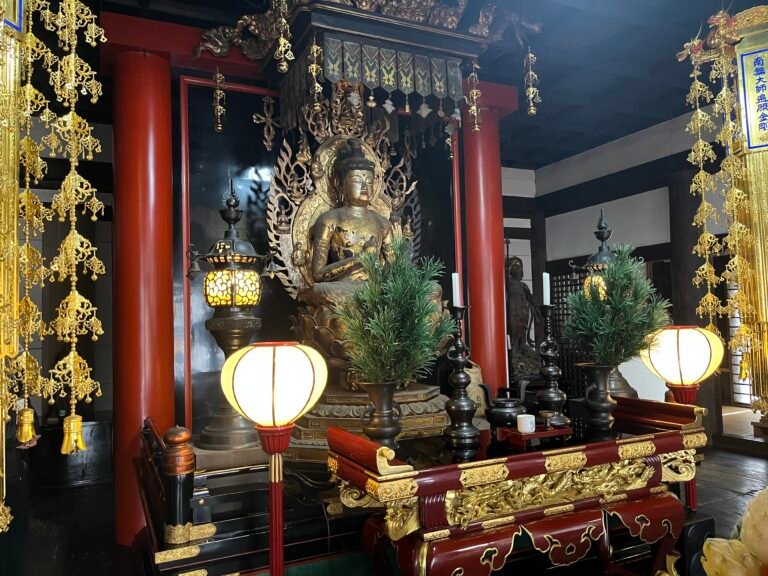
In Kudoyama, a town at the foot of Koyasan, stands Jison-in Temple.
Located near the beginning of the historic Choishi-michi pilgrimage route, Jison-in once served as an administrative centre for Koyasan and provided accommodation for pilgrims.
It also became an important place of worship for women who could not enter the mountain.
For this reason, Jison-in became known as Nyonin Koya, or Women’s Koyasan.
The temple is closely associated with a local tradition about the mother of Kobo Daishi, whose birth name was Kukai.
According to the tradition, Kukai’s mother travelled to see her son but could not enter Koyasan because of the restrictions on women. Instead, she stayed at Jison-in, below the mountain.
Kukai is said to have descended from Koyasan nine times each month to visit her.
This story is traditionally connected to the name Kudoyama. Written in Japanese characters, ku means “nine,” do means “times,” and yama means “mountain.” The name is thus associated with Kukai’s nine monthly journeys down the mountain.
Today, Jison-in continues to welcome visitors who pray for safe childbirth, family well-being, and other personal wishes.
The name Women’s Koyasan is not limited to Jison-in. Other temples, including Muroji in Nara Prefecture and Kongoji in Osaka Prefecture, also have histories of welcoming women as worshippers.
Together with Koyasan’s surviving Nyonindo, these places are recognised in a Japan Heritage story titled Women’s Koyasan: A Living Tradition of Faith.
Discovering Koyasan Beyond Its Sacred Centre
Koyasan’s history is not preserved only in the temples and religious treasures found on the mountain itself.
It also lives in the women’s prayer halls, the forest paths walked by generations of pilgrims, and Jison-in Temple at the foot of the mountain.
Learning about these places offers another way to understand Koyasan.
When we travel, it is natural to focus on famous landmarks and the destinations we have come to see.
Yet sometimes, the details that help us understand a place are found a little further from its centre.
If you are planning a visit to Koyasan, consider looking beyond the mountain itself, towards the villages, temples, and paths that have shaped its history.
There is another side of Koyasan waiting to be discovered.
Sources & Further Reading
Japan Heritage — Women’s Koyasan (Agency for Cultural Affairs)
Koyasan Kongobuji Temple — Places to Visit
Wakayama Official Tourism — Jison-in Temple
Continue Exploring
More stories from the foothills of Koyasan.
The Story Behind the Name Hashimoto
Related Posts
 Three Small Shrines of “Tsuma no Mori” Hashimoto Here, tucked quietly into the neighbourhood, is a small sacred place known… ...
 Who Was Mokujiki Ōgo? Koyasan, mokujiki-ogo, Ogo-Shonin Mokujiki Ōgo (c. 1536/1537–1608) was a Buddhist monk associated with Koyasan during… ...